
India's exports remained in the negative territory for the 11th month in a row.

It would be a miracle indeed if we grow at 7/8 per cent a year over the current and next few years, says A V Rajwade
The rupee fell to an all-time low of 61.21 per dollar, forcing the Reserve Bank of India to intervene to stabilise the currency.

The Centre's fiscal deficit for the first two months (April-May) of the current fiscal has increased to Rs 90,758 crore, which is 27.3 per cent of the Interim Budget estimate, according to the Controller General of Accounts data released on Tuesday. The Budget estimate for the fiscal deficit in the year 2009-10 is Rs 3,32,835 crore.

To offer additional support at the low end of the income ranges, the Centre will consider a large-scale jump in exemption rates under the old income-tax regime in the vote on account, or interim Budget, according to a senior official in the know. Those will include an extension of the income tax exemption rates close to Rs 7 lakh and additional measures for women farmers.

For last fortnight, the tariff value of gold was fixed at $382 per 10 grams and silver at $516 per kg.

The government has hiked import duty on gold three times in a year and recently raised it by 2 per cent to 8 per cent to curb demand.

How much are others responsible for the Trump presidency moving in the directions it has, asks T N Ninan.

Volatility ain't going away any time soon. 2013 was the most volatile year for the rupee in at least the last 10, with 2009 not far behind.

Citing the massive surge in Omicron infections and the resultant impact on overall economic activities in the March quarter, Swiss brokerage UBS Securities has revised downwards its India's growth forecast for the current financial year to 9.1 per cent from 9.5 per cent earlier. However, UBS Securities does not see the third wave impact extending to the next financial year as it has revised upwards its real GDP forecast to 8.2 per cent, up from 7.7 per cent earlier, expecting the real GDP growth to remain well above the historical average. The World Bank pegs it at 8.3 per cent, unchanged from its June assessment, saying the recovery is not broad-based yet.

Policymakers should aspire to restore the pre-Independence environment where the rupee was trusted and used all over South Asia, in Southeast Asia, in West Asia, and in East Africa, suggests Ajay Shah.
.jpg)
Policymakers stepped in late Thursday to calm markets.
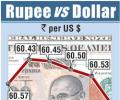
Forex dealers said besides dollar's gains against other currencies, increased demand for the American unit from importers put pressure on the rupee, but a higher opening in the domestic equity market limited the losses.
'As long as economic growth remains steady, creating jobs and generating stable incomes, the rise in home loans should not create problems.' 'If the growth trajectory changes course over the medium term and interest rates rise along with inflation, the expanding trend in home loans may not sustain.'

Gold prices were ruling at Rs 26,385 per ten gram at the bullion market while silver was quoted at Rs 34,000 per kg.
Fiscal deficit touched Rs 90,678 crore (Rs 906.78 billion) during April-August, 2006, which accounted for 60.98 per cent of the budgetary target of Rs 1,48,686 crore (Rs 1,486.86 billion) for the whole year, he said in Delhi on Friday.

Finance Minister Arun Jaitley on Friday tabled the pre-Budget Economic Survey in the Lok Sabha.

The likelihood is that India will maintain a moderately upbeat economic tempo -- well short of tearaway growth, explains T N Ninan.

Foreign portfolio investors (FPIs) turned net buyers in October after being net sellers in the previous month. In October, FPIs bought shares worth nearly Rs 8,430 crore ($1 billion) against net selling of Rs 13,405 crore ($1.6 billion) in September. Positive flows during three of the previous four months have pushed the domestic markets towards fresh all-time highs. At present, the Sensex and Nifty are less than 2 per cent shy of breaching record highs logged in October 2021. A rally in equity markets in the US and Europe is in hopes that the Federal Reserve may go soft on rate hikes after its November meeting.

Credit rating agencies have been raising red flag over high debt to GDP ratio of India.
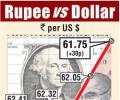
The rupee resumed higher at 61.75 as against the last closing level of 62.05 per dollar at the Interbank Foreign Exchange (Forex) Market and firmed up further to a one-month high of 61.53 before quoting at 61.59 per dollar at 1045 hours.

Expressing disappointment over the RBI's move for not cutting the key policy rates, India Inc on Tuesday asked the government to take immediate action to revive growth and boost investments.

The fiscal deficit in the first five months of the current fiscal ended August stood at Rs 3.69 lakh crore, or 66.5 per cent, of Budget estimates for 2015-16.

Technically, USD/INR remains well below its 200-day moving average after first breaching that trend level on Thursday for the first time since May 2013, adding to the optimism on the rupee.

The sudden movement of the rupee - post the monetary policy - is not a reason to panic, said currency dealers. According to them, a correction was overdue for the rupee that remained the best performing currency in the region for well over a month. The rupee closed at 74.72 a dollar on Friday from its previous close of 74.60. It had dropped 1.52 per cent against the dollar on April 7 after the Reserve Bank of India (RBI) announced its monetary policy, committing to buy Rs 1 trillion of bonds in the June quarter. A weak rupee goes well with the export narrative of the government, and is consistent with the RBI's intervention strategy that prevented an appreciation.

India has much to be proud of and celebrate. But there is also much that is wrong, much that looks dangerous. Employment, current account deficit, rural distress, agricultural productivity are all in deep crisis, points out Shekhar Gupta.

India's biggest jewellers' association has asked members to stop selling gold bars and coins.

The government Rs 20 lakh crore package includes Rs 1.7 lakh crore of fiscal stimulus announced in the first phase, Rs 5.6 lakh crore stimulus provided through various monetary policy measures and Rs 5.94 lakh crore through the second phase, implying Rs 6.70 lakh crore package is still to be announced.

The broader NSE Nifty reclaimed the key 10,100-mark and touched a high of 10,155.65, before finally settling at 10,124.35

The revision in base year of India's national accounts will increase the size of the economy to Rs 111.7 trillion in FY14, India Ratings (Ind-Ra) said on Wednesday.

After a contraction in the current financial year, India's economy is forecast to bounce back with a sharp growth rate of 9.5 per cent next year provided it avoids further deterioration in financial sector health, Fitch Ratings said on Wednesday. The coronavirus pandemic will lead to shrinking of the already slowing economy in 2020-21 that started in April. Fitch Ratings forecast a 5 per cent contraction in the GDP in the ongoing financial year.

For 2017-18, the government aims to bring down the fiscal deficit to 3.2 per cent of the GDP. Last fiscal, it had met the 3.5 per cent target.

The rupee has been falling for five straight weeks, taking its losses this quarter to 6.6 per cent, making it the worst performing currencies in Asia during this period.

India's record current account deficit has been a key reason behind why Standard & Poor's and Fitch Ratings cut their outlooks on the country's sovereign rating to 'negative' last year.
.jpg)
India's trade deficit widened to $20.1 billion in May because of high gold imports while exports declined by over a per cent, raising concerns about economic recovery.

Inflation, which has been at high levels, is also a key challenge for the country, Thomas J Richardson, the IMF's Senior Resident Representative in India and Nepal, said in New Delhi on Wednesday.

The import tariff value is the base price at which the customs duty is determined to prevent under-invoicing.

The Rupee is 3.7 per cent undervalued on trade related basis.

The government pushed import duty on gold jewellery up by half to 15 per cent, the finance ministry said on Tuesday, setting it higher than raw gold duty in a move aimed more at protecting the domestic jewellery industry than stemming bullion imports.
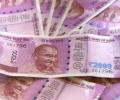
For 2017-18, the government aims to bring down the fiscal deficit to 3.2 per cent of GDP. Last fiscal, it had met the 3.5 per cent target.
 © 2026 Rediff.com - Advertise with us - Disclaimer - Privacy Policy - Sitemap - Feedback - About us - Terms of use - Grievances